
En creux : what if the empty spaces told a different story?
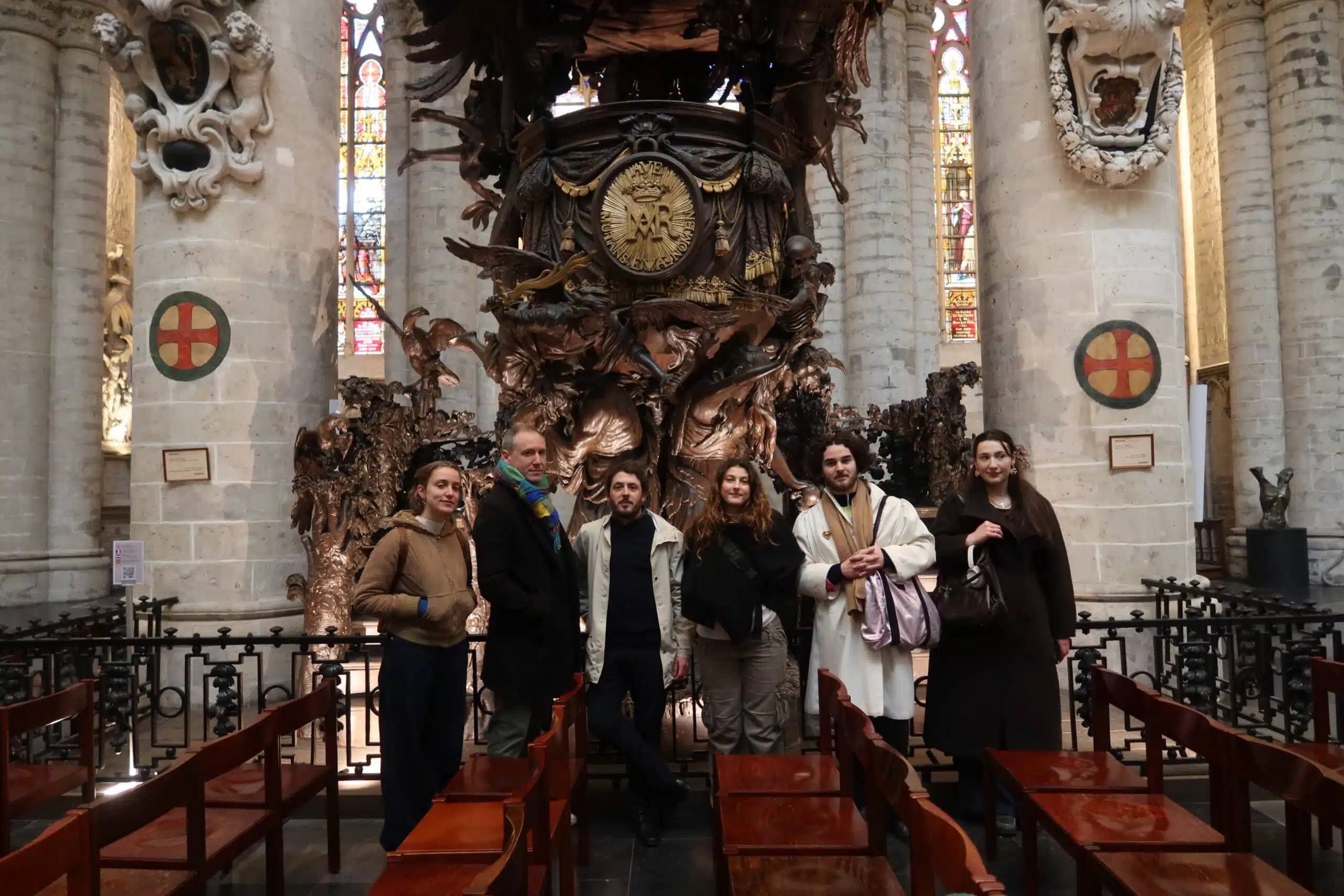
At the Cathedral of St. Michael and St. Gudula, the pulpit, a Baroque jewel damaged by the
passage of time, is the subject of a unique project: En creux. Artists, students, heritage restorers
and scientists are combining their perspectives to reinvent the memory of lost forms. A lively, collective and experimental approach, where heritage becomes a source of creation, reflection and transmission.
Developed as part of an art seminar organised by the Royal Academy of Fine Arts of the City of Brussels – École supérieure des Arts (ArBA-EsA), the KIK-IRPA, the cathedral’s church workshop, and artists Stephan Balleux and Florian Kiniques, ‘En creux’ accompanies the restoration process of the pulpit.
It is aimed at a group of students ranging from Bachelor’s to Master’s level in the fields of architecture, urban planning, landscape architecture, design, fine arts, and other related disciplines.
The project involves the creation of a series of drawings, photographs, and videos documenting the restoration process of the pulpit. It is aimed at a group of students ranging from Bachelor’s 1 to Master 1, and offers a theoretical, technical and practical approach. Led by Florian Kiniques, lecturer at ArBA-EsA, and Stephan Balleux, co-professor of the painting workshop, this seminar invites participants to think and create in relation to heritage, based on the voids that run through it.
Through this symbolic work and the absences that inhabit it, participants will conduct personal artistic research nourished by different perspectives and rooted in the contemporary issues
of transmission, memory and transformation. Conceived in the spirit of open and experimental art research, the seminar aims to bring about the unexpected. The forms of restitution remain to be imagined, but exhibitions, conferences and public presentations are already being considered.
‘En creux’ is therefore not just a restoration project: it is an invitation to think differently about heritage, to approach it with boldness, sensitivity and subtlety, and to create a dialogue
between the centuries in a living visual language rooted in our time.
- 15/09/2026 - 15/12/2026
- Ongoing...
- All Day